Market report
Q1 2026 Market Analysis: EIFS, Façade Systems & Building Envelopes in Canada and the USA
Prepared from a construction and architectural market perspective The first quarter of 2026 has confirmed a major shift in the North American construction industry toward high-performance façade systems, prefabricated building envelopes, and energy-efficient EIFS solutions. Across both Canada and the United States, developers, architects, and contractors are increasingly prioritizing systems that reduce labour dependency, improve […]
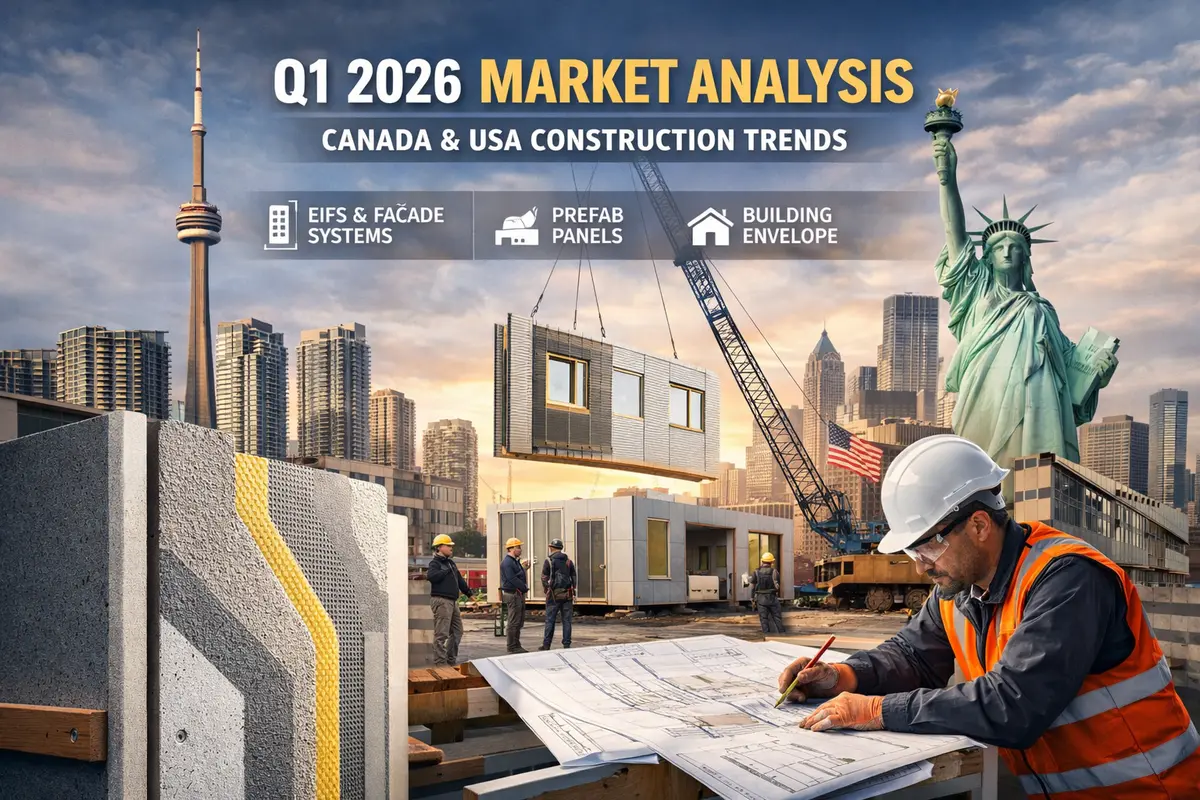
Prepared from a construction and architectural market perspective
The first quarter of 2026 has confirmed a major shift in the North American construction industry toward high-performance façade systems, prefabricated building envelopes, and energy-efficient EIFS solutions. Across both Canada and the United States, developers, architects, and contractors are increasingly prioritizing systems that reduce labour dependency, improve thermal efficiency, accelerate project timelines, and comply with evolving building codes.
As labour shortages continue, material costs fluctuate, and sustainability requirements tighten, the demand for [prefabricated EIFS wall systems](/services/eifs-installation) and advanced façade technologies has moved from a niche market into a mainstream construction strategy.
Canadian Construction Market Analysis – Q1 2026
Canada’s construction sector entered 2026 with strong momentum in the areas of multi-family residential, institutional buildings, and modular construction. Provinces such as Ontario, British Columbia, Alberta, and Quebec continue to face housing supply pressure, driving demand for faster and more efficient construction methods.
Growing Demand for Prefabricated Building Envelope Systems
One of the most significant trends in Canada is the rapid adoption of prefabricated façade systems and EIFS panels manufactured off-site. Developers are seeking alternatives to traditional site-installed cladding due to:
- Skilled labour shortages
- Unpredictable weather conditions
- Rising construction timelines
- Increased insurance and financing costs
- Stricter energy-efficiency requirements
Architects are increasingly specifying continuous insulation systems and high-performance exterior wall assemblies to meet modern building standards and improve long-term building performance.
Prefabricated EIFS systems provide:
- Faster installation schedules
- Improved quality control
- Better thermal performance
- Reduced site waste
- Lower labour exposure
These advantages are especially important for:
- Mid-rise wood-frame residential projects
- High-rise mixed-use developments
- Institutional and educational buildings
- Retrofit and energy-upgrade projects
USA Market Analysis – Q1 2026
The United States façade market continues to expand aggressively, particularly in the Sun Belt states including Texas, Florida, Arizona, and the Carolinas. Population growth, commercial expansion, and large-scale residential development are driving the need for scalable façade solutions.
Shift Toward Industrialized Construction
A major trend in Q1 2026 is the increasing move toward industrialized constructionand off-site prefabrication . General contractors are under pressure to reduce schedule delays while maintaining quality and code compliance.
As a result, developers are actively exploring:
- Prefabricated EIFS panels
- Modular wall systems
- Pre-engineered building envelope assemblies
- Fire-rated mineral wool façade systems
The USA market is also seeing stronger demand for:
- Hurricane-resistant façade systems
- Moisture-managed wall assemblies
- Non-combustible insulation solutions
- Sustainable building envelope technologies
In high-growth regions, the combination of labour shortages and rapid urban expansion has created ideal conditions for the adoption of prefab façade technologies.
Architectural Perspective: Why EIFS Continues to Grow
From an architectural standpoint, EIFS (Exterior Insulation and Finish Systems) remains one of the most versatile and energy-efficient cladding systems available in North America.
Modern EIFS systems now offer:
- Advanced drainage technology
- Enhanced fire-rated assemblies
- Greater design flexibility
- Improved moisture protection
- High-performance thermal insulation
Architects continue to favour EIFS because it allows the creation of:
- Contemporary smooth façades
- Brick and stone appearance finishes
- Lightweight wall systems
- Complex architectural details without excessive structural loads
The integration of mineral wool insulation and advanced air/moisture barriers has also strengthened EIFS acceptance in mid-rise and high-rise construction.
The Rise of Prefabricated EIFS Panels
One of the strongest market shifts observed in Q1 2026 is the move away from traditional field-installed EIFS toward factory-manufactured prefabricated wall panels.
The reasons are clear:
1. Construction Speed
Projects can reduce exterior envelope installation time by up to 30–50%.
2. Better Quality Control
Factory conditions allow precise assembly and reduced installation variability.
3. Labour Efficiency
Reduced dependency on large site crews helps contractors manage labour shortages.
4. Sustainability
Off-site fabrication reduces waste and improves material efficiency.
5. Weather Protection
Controlled manufacturing minimizes delays caused by rain, snow, and cold temperatures.
These advantages are driving interest from:
- Developers
- General contractors
- Architects
- Institutional clients
- Government-supported housing initiatives
Market Outlook for 2026
The outlook for the remainder of 2026 remains highly positive for the façade and building envelope sector across North America.
Key Growth Drivers:
- Government housing initiatives
- Energy-efficiency regulations
- Labour shortages
- Demand for faster project delivery
- Sustainable construction practices
- Increased adoption of modular construction
The strongest growth is expected in:
- Prefabricated façade systems
- EIFS building envelope solutions
- Mineral wool fire-rated wall systems
- Modular construction technologies
- Retrofit and building modernization projects
Companies capable of delivering engineered prefab façade solutions with strong technical support and scalable manufacturing capacity are expected to gain significant market share over the next several years.
Conclusion
Q1 2026 has demonstrated that the North American construction industry is moving decisively toward high-performance prefabricated façade systems and advanced EIFS building envelope technologies.
Canada and the United States are both experiencing increased demand for:
- Faster construction methods
- Sustainable building systems
- Energy-efficient wall assemblies
- Factory-built exterior envelope solutions
As the industry continues evolving, prefabricated EIFS technology is positioned to become a leading solution for modern residential, commercial, and institutional construction projects throughout North America.